Showing posts with label Roguelikes. Show all posts

09 April 2025

Sir, You Are NOT Being Hunted part 2

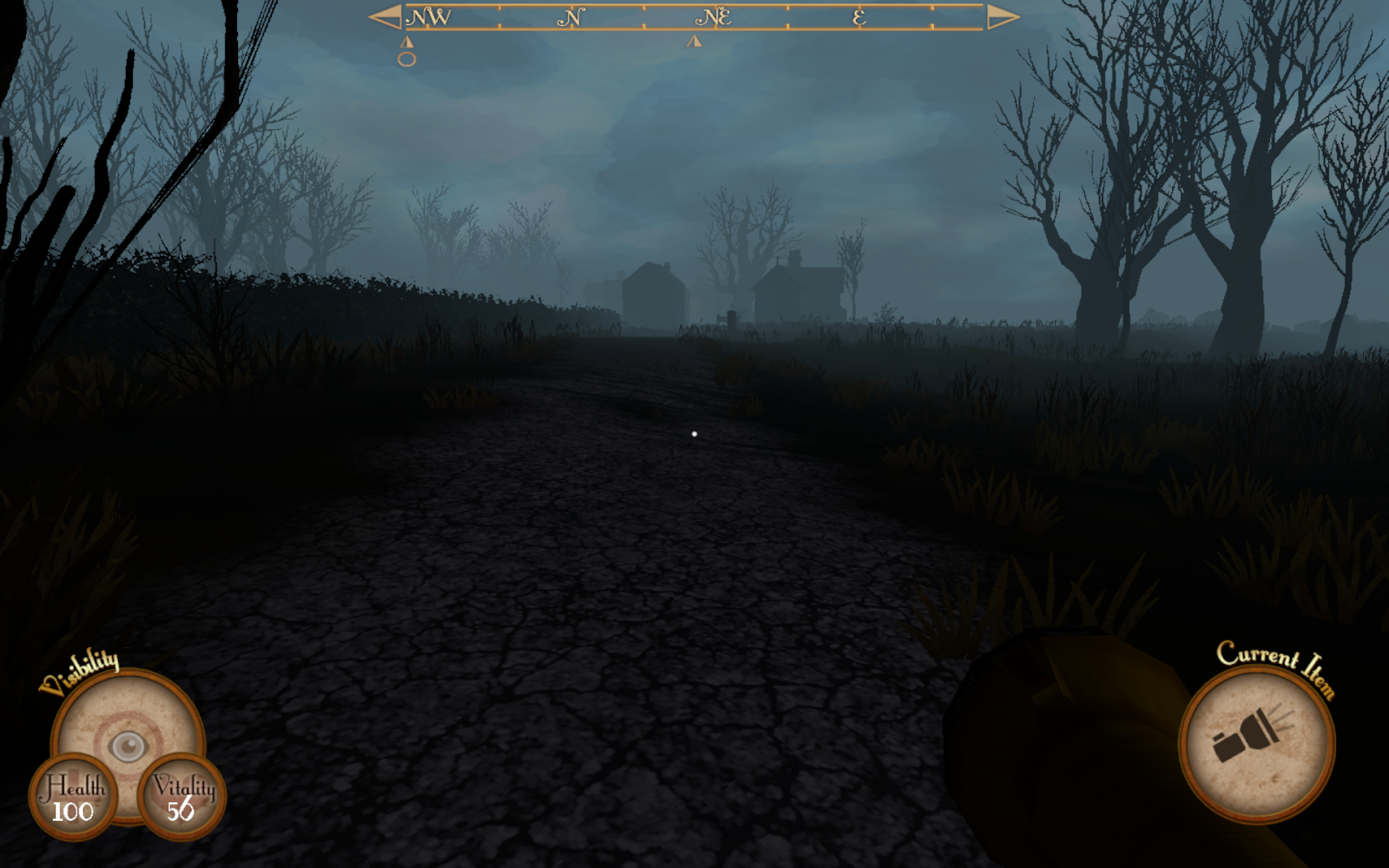
 So I decided that I need some gaming to relax my mind. Like, really relax it. That got me an idea: What if I take an old favourite of mine, Sir, You Are Being Hunted, and turn it into a walking simulator? No threat. Just the moody, gloomy, but ultimately pretty and relaxing British countryside and the need to eat every once in a while? The game certainly makes that possible, without having to be modded or anything. Here's part two:

The pier of the North Island greets me in gloomy weather. It's the industrial island, which in this mode is a paradise for urban explorers. I'm just a hiker though, so I decide to spend as little time in this gloom as possible.

With my binoculars I spy a church in the fog. I decide to go there first and check it out.

I get drunk on mess wine found in said church and enjoy the sunrise.

The next larger structure that lures me closer with its bulk is an old warehouse, I assume. I decide to see what's up in there.

Dynamite! Lot's of it. While there are not enemies to speak of in this world, in real life a bunch of dynamite in a depopulated area means fun so I pocket as much as I can sensibly carry.

I arrive at the outskirts of the industrial town. It still feels like trespassing.

The place is a dump. Literally. I think I'm climbing over a junkyard to get into town.

I normally like waterside properties. I wouldn't want to live here though. But that may just be the weather.

I decide to follow a sprite I see. I don't want to stay on this island forever.

There we go. I don't know what route I took to get here but there are two telebits in somewhat close proximity to each other. In a regular game of Sir, this would be dangerous because you'd have to deal with at least two teams of hunters at the same time. Here it's a nice convenience.

I see the bog monster and toss a stick of dynamite at it. No idea if the explosion drove it off because I overshot by quite a bit. Next time I'll pepper the freaking thing with lots of explosives. Also I realize that the pier is right here – I must have walked around most of the island.

In the dark I use the flashlight to follow another sprite towards the last telebit of the island.

At a factory building I find even more dynamite. I can't carry any more so I do the sensible thing: I get utterly wasted on sherry and toss a bunch of dynamite sticks into the landscape. Blowing stuff up while drunk is the sort of irresponsible fun one can do when alone in post-apocalyptic Britain.

There's the last telebit. After restocking my dynamite stores somewhat, I go and get it.

The way back leads me past an ominous tower. It reminds me of the electric towers at the edges of some villages I know from middle Germany.

I go through a village with the funny name of Misty Cheating. Sounds like a porn starlett.

And discover the overgrown ruin of a factory.

It reminds me of two things: First, an old factory I urban explored on Rhodos. And then of an old monastery church somewhere by the Mosel where we pitched our tents and slept when I was a teenager and we were doing a long-distance tour with the school's rowing club.

When it gets light again, I reach the boat. Time to go back to prettier shores.

To be continued.


13 March 2025

Sir, You Are NOT Being Hunted part 1

So I decided that I need some gaming to relax my mind. Like, really relax it. That got me an idea: What if I take an old favourite of mine, Sir, You Are Being Hunted, and turn it into a walking simulator? No threat. Just the moody, gloomy, but ultimately pretty and relaxing British countryside and the need to eat every once in a while? The game certainly makes that possible, without having to be modded or anything. So I got to work:

No evil robots appearing with these settings. It'll be just me and some wildlife. Perhaps I can even hunt and cook a pheasant? Never done that in the game before, I was always too afraid of lighting a fire and didn't want to waste ammunition. I let the British Countryside Generator do its thing and then go into the game world.


After the short tutorial-steps that always start the game, I decide to head for the nearest village. Since I'm not a man on the run, I walk there leisurely and don't cross the field. Wouldn't want to trample someone's harvest. I make my way along the fence, through a small thicket and then reach Leafy Eating.


Despite the sign at the village entrance, the place is calm and quiet. As I need some supplies for the exploration to come, I go looting all the houses like I would in a regular game of Sir – albeit at a much slower pace. In real life I wouldn't run in this situation, so why should I do that here?


As night starts to fall, I head towards a ruined farm next to the village. I do something I never do in a regular game of Sir and switch on the flashlight I found in one of the houses.


This makes exploration a lot easier. I now feel a bit like I'm urban exploring. Nice.


I make my way along the road towards the next village. It's called Kings Burrow.


Since I'm starting to get thirsty/hungry, I chug down a bottle of sherry, to the usual effect. Drunkenly I stagger through the deserted village.


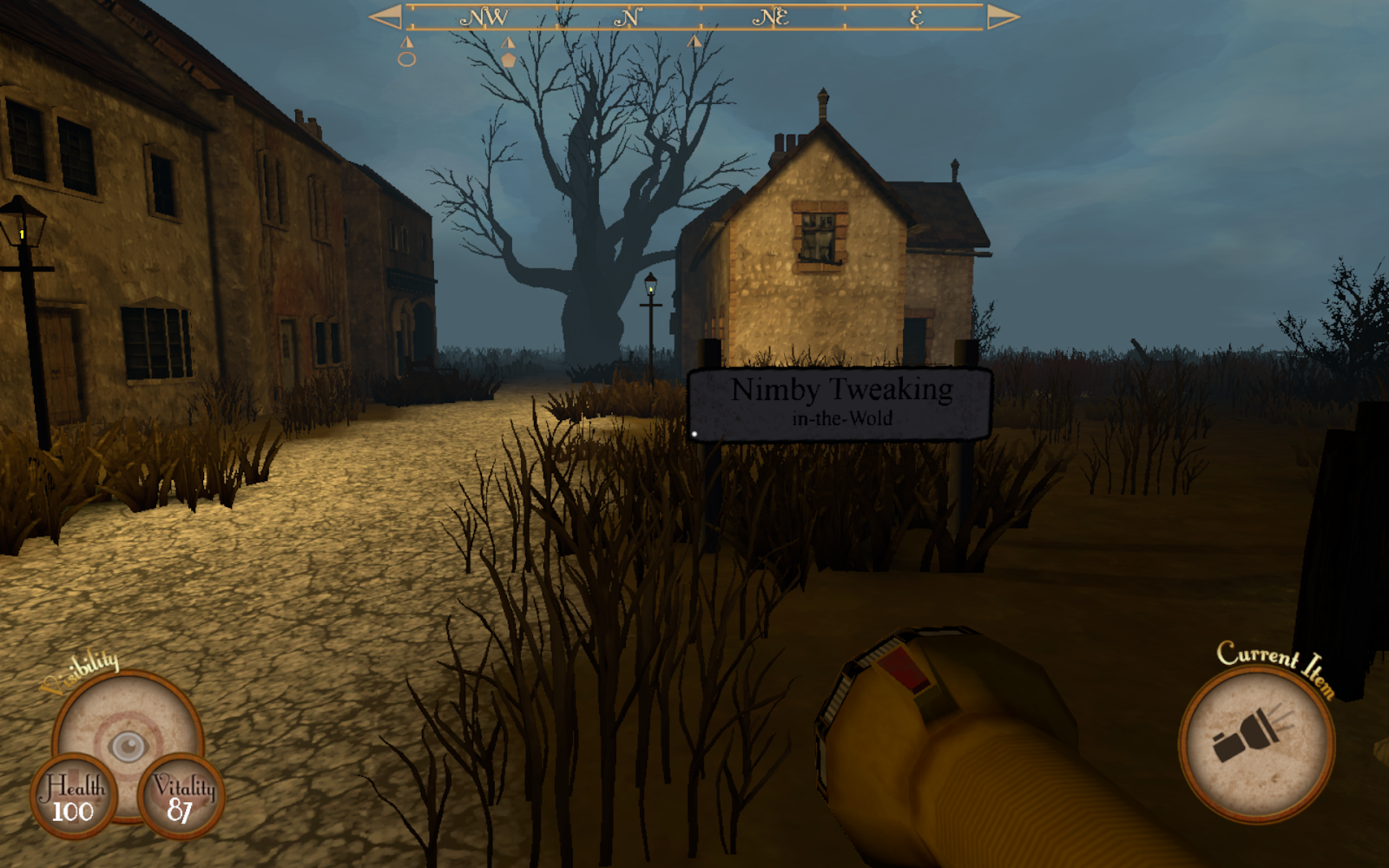
And then, sobering up, down the road towards Nimby Tweaking in-the-Wold.


I gather whatever the residents of Nimby Tweaking have left behind and seems useful to me. Then I tetris my inventory so it looks nice and ordered. I think I'm ready for a nice hike on one of the outlying islands.


The road going through Nimby Tweaking terminates around a large, dead tree. Where I'm from this would be the village oak.


I follow coast towards the first boat. I plan to collect the teleporter bits on the centre island last. So, next up: The North Island.


It's a calming experience to play this game like that. Birds are chirping. I met a hare. It's a bit like playing a homeless person in a post-apocalyptic Britain. But the nice kind of apocalypse, that left nature intact and only removed most people.

05 January 2023

Free Release: Nano Dungeon

After Christmas celebrations were over I had a tiny box and decided to craft a roguelike dungeoncrawler into it. It turned out so well that I decided to make a print-and-play-version of it:


Nano Dungeon is a board game for one or two players. It's been play-tested with friends, family members and children aged 3 to 42 so I can say with confidence that it is both easy to learn and fun to play. Give it a shot – it's pay-what-you-like starting at the ultra-cometitive pricing of 0 Dollars/Euros/Baht/RMB/Yen/Tugrik/Pesos/Whatever. Have fun!

10 April 2022

Free Release: The Swine Pit

 More than a year in the making, it's finally here: My very first roguelike made in Twine:

The Swine Pit

Play it in your browser - it's a Twine game after all. But it's very unlike any other thing I've ever seen made with Twine. Possibly, because it was a mad folly to create a roguelike with that platform, but it's the one I can code in so that's that.

Descent into a horrible dungeon full of swine-like monstrosities posessed by the demons of hell. Experience the harrowing story of one out of seven different character classes, who all have different abilities that make their playing experience radically different. Cast spells as the apprentice or the scholar, brew potions as the alchaemist, craft your own weapons and cook food as the huntsman, or survive by your brawn alone as the squire or the tribal. Or die horribly as the sacrifice.

08 April 2022

Working on: A Rogulike. Made in Twine.

 So for the past year or so I've been (on and off, of course) working on a new roguelike. It's not my first foray into designing one: I've attempted to make them in the form of books (semi-successful: It's a good adventure-riddle but not roguelike beyond having a randomized labyrinth layout), board games (close. But better as a traditional board game co-op experience), text-adventure video games (that's more like it - but alas, I didn't do the coding) and low-resolution retro-games (not the roguest of roguelikes but also close - also a collaborative effort with my friend Niels). Now this time I've done everything myself, using the only platform I can do some coding in - Twine. Twine 1, that is.

Can one make a roguelike in Twine? With some limitations: Yes. I did it. It's pretty much finished, all I need to do is publish it on my Itch-site, which I plan on doing this weekend. Let's do a little post-mortem on the project.


Making a roguelike in Twine

Twine wasn't made for creating roguelikes, obviously. The main strength of the platform is that a layman such as myself, more interested in writing than in coding, can make a functioning piece of interactive fiction without much foreknowledge. Starting from relatively humble beginnings I learned to use more and more of the coding language features until I was able to make first a text-based survival-horror-game and then an hommage to Resident Evil. But creating my roguelike was a totall different beast. It started with a random maze, then I added parts of the combat- and inventory-system from Zombie Mansion, then I made a system for placing random monsters, loot and room features.

Technically, you do the same floor over and over again: There are only 25 'rooms', wich get different walls/passages, features, treasure-items and monsters every time you descend to the next floor. The rules for filling the rooms change when you go deeper though - as do the stats of your character when you level up. The whole thing has a high level of complexity. Here are some stats of the Twine project:

  • 160 Passages
  • 424 Variables
  • 21 Types of Monster
  • 7 Character Classes
  • 50+ Types of Item
  • 12 Spells
  • 6 Potions
  • 25 Floors total
    • 5 Curated floors with boss fights
    • 4 Floors where there is a trader to do trade with

In the editor, the whole thing looks like this:

The character classes (on the left) all actually play very differently: You have fighty characters like the Squire, who just stabs enemys with his spear. You have casters like the Apprentice, who can learn spells from scrolls to use them many times. You have utility-classes like the Scholar who will fill her journal with lore about the dungeon when you go deeper - and can later scrounge for scrolls (which kind of makes her a caster class as well). Many items have multiple uses: You can use a thighbone you find for combat or sacrifice it at a firepit for a health-boon. Potions can be drank, hurled at enemies or poured onto things. The seven classes each have a specialty:

  • Squire: Offense in combat
  • Tribal: Defense in combat
  • Apprentice: Magical spells
  • Alchaemist: Potions
  • Scholar: Lore and nerdery and some spells
  • Sacrifice: None, this is the difficult class
  • Huntsman: Crafting and cooking
The project started out as a generic dungeon in a medieval world. When I made more characters and enemies, the world started taking a more unique shape. The Swine Pit, the dungeon of the game, became a hellish hole in the ground filled with demon-posessed swine-creatures and their retainers. My fandom of Darkest Dungeon definetly shows in a lot of the descriptions.

I'm also quite proud that the majority of monsters have special moves that go beyond direct attacks: Some may beat your weapon out of your hands, some can destroy armour, some displace themselves, steal your mana or HP or regenerate or steal food from your pack. Same goes for bosses: At the very least they have special attacks and two of the boss fights can be outright avoided if you have the right tactics or items. Speaking of items: Some of them are incredibly powerful and once you master the game these are the ones you want to keep for specific situations such as boss fights. Even the final boss can be two-shotted with the right spell.

What doesn't work?

Twine is, as I said, not made for making a game like this. Besides the total lack of a visualized map (draw your own - the game does provide grid-coordinates in every room), monsters are mostly immobile. There are some exceptions: 
  • The second boss enemy moves about in a specific area, a trick that I learned making Zombie Mansion. The process is too complex and unreliable to be used at scale with regular enemies though - especially when considering that the boss level is curated and walls and passages are always the same, unlike on regular floors that are totally randomized.
  • The enemy types of Madman and Infected Madman sometimes just "run off into the darkness". I stayed vague on purpose: The game doesn't know how to respect walls in this instance and just places the creature and its HP in a random different room. Works for a creature that is insane and incoherent, but not for other enemies. It can also lower the total number of enemies on the floor because it will overwrite the monster in its target room - so I had to use this ability sparingly.
  • There are some mobile monsters on the floor of the third boss but they are rather buggy and sometimes do not move at all.
Twine is also not the best for testing your software. I did make a test-character who can jump to the next level at will and has all possible items in his inventory but even then it's a chore to test, say the final boss fight on floor 25 multiple times. That means that the later stages tend to have more issues with them. As I wanted the boss fights to be special, it was difficult to do QA there.

You can't go back up to a floor you've finished. This is because the floors are randomized during transition. Story-wise I made it so that you actually jump down into the darkness every time and there is no way to climb back up. That takes away some of the tactical options a roguelike might have, such as going back to a trader. But it can't be helped.

There is no way to save the game. I am aware that other versions of Twine have features for that but to be honest, I can't be bothered to learn another programming language after putting all that work into regular vanilla Twine 1. I'm still angry with the makers of Twine 2 going "well, we made it and most of the codes work like programming language X so whatever go figure it out" when the target audience for Twinery is people who specifically cannot code. I got my start with a blog post by Anna Enthropy and learned from there but please, people, don't assume that you make this tool for other coders.

I have another Twine game in the works - a sequel to Zombie Mansion. As the platform is what I've become proficient with, I will likely keep using it as a creative outlet. Also, I'll keep making (more professionally coded) games with Niels. We do totally need an artist though - our pixel art doesn't cut it in the long run.

27 January 2020

On Catacomb Kids

Sometimes you find a game that just clicks with you. I like me a good roguelike (or -lite or whatever definition you personally think should be universally applicable for the term) and last month I bought the early access version of Catacomb Kids. I love it.

The game itself plays like a more rogue-ish version of Spelunky (which I loved as well, at least the original free version, which I beat more often than my schedule these days would ever allow for). You jump and run through an often very vertical level in an old-school side-view. Unlike Spelunky, Catacomb Kids has a lot of different weapons, many of them magical, with random stats. Also there is the roguelike tradition of unidentified potions. And spells – a lot of them.

Combat can get frantic and intense but also slow and stand-off-ish. When a grumbul and you are facing each other across a pit with spikes, waiting for the other to move, that's where the true drama comes in. The fact that these enemies operate on the same rules as you and will flee the level if injured too badly makes things more immersive. And I always prefered games where even a single enemy is of consequence and a credible threat. I do, however, usually die to some trap combined with my lack of youthful reflexes.

I really enjoy the short sessions this game allows for: I rarely have more than half an hour of game-time a piece since we had our second kid. As I am not yet very good at Catacomb Kids, I rarely last more than ten minutes per run. The only problem is resisting the urge to do just one more try several times in a row.

Now the game is far from finished and I have some performance issues on my old computer here. Still, it's one of my favorite experiences in video gaming in the past ten months or so. I recommend anyone who likes a good action-oriented roguelike to try it out.

08 November 2019

Forms of Game and the Roguelike

When I started MadZabGaming, I did so with the intend to go into the full spectrum of gaming. I still hold by that sentiment and can look back on a diverse portfolio of things I have created games-wise. People who know me personally know that I love me a good roguelike. I like to explore and when I create a roguelike, the procedural world-generation can surprise even me as its creator.


27 April 2017

A Let's Play!

So, Choose your own CaveVenture got its first let's play. The guy was kind enough to tell me so in a comment on the release-posting. If you want to see someone go into the cave blind (so to speak), enjoy this:


I shall repeat my statement I made in the video comments: I'm totally willing to do a co-commentary on any play of my game via Skype or something.

07 June 2014

What I've been working on...

So here's, what I've been (next to my new real-life-feedin'-the-family-job) working on: A board-game roguelike. I'll give out some more details after more testing with my hand-made prototype. Here's a sneak-peak at how the game looks in action:
Not the first of its kind. But it's mine.
The game so far features:
-Variable Characters with different race-, skill- and attribute-cards.
-Randomized monsters with different sets of ability- and stat-cards.
-Lots of loot-cards including weapons, armor, spells and more.
-A 5 x 5 tile dungeon to be explored. Featuring obstacles, traps, monsters and treasure.
-A simple  yet elegant XP system that allows for single- or multiplayer-campaigns.

21 April 2014

New Release: Choose your own CaveVenture 1.1

Just a quick heads-up: Choose your own CaveVenture has gotten a new release, version 1.1. It features rest-until-healed as a function, configurable keys, as well as monster-status messages. Also, Linux-version.


There will be more later. The game is only about halfway-done. Stay tuned.

16 February 2014

Release: Choose your own CaveVenture

It is done! Choose your own CaveVenture, our first actual PC game, is now available on itch.io!

It's free, so if you're on a Windows-machine, go try out this crossbreed of choose-your-own-adventure and roguelike. Unlike many of the more complicated roguelikes, CyoCV plays using an interface that anyone who reads English can understand and play: Text tells you what the situation is, then you get options what to do. Pick an option, hit the key it says on the screen, enter and the game tells you what happens.

The title-screen ASCII-art - all the graphics in the game.
The Baumannshöhle, my inspiration for the game's cave. Picture is public domain via Wikipedia.

Go, check it out, leave any feedback in the comments on this post.

Thanks!

31 January 2014

How to beat a Roguelike: Pixel Dungeon part 2

A lot of modern roguelikes (and I use that term in a very broad manner - once again screw the Berlin interpretation!) have nice graphics and easy-to-learn interfaces that make them accessible for more and more players - who then run against a wall of difficulty. Don't despair, in this series of posts I shall shine some light on those that I have played and beaten and give some tips regarding strategy and practice on each individual game.

Last time I wrote about the first two bosses of Pixel Dungeon, how to get there and how to beat them. This time we'll delve further into the depths, seeing what we can do about the other three bosses and their minions. After you beat the Tengu, the game curves up a little, getting more difficult. If you have beaten the Tengu, however, you get a book that lets you specialize your character class further - and that is something you get for every future play-through on that class. What to do to get through the caves though? Read on!

23 January 2014

How to beat a Roguelike: Pixel Dungeon part 1

A lot of modern roguelikes (and I use that term in a very broad manner - once again screw the Berlin interpretation!) have nice graphics and easy-to-learn interfaces that make them accessible for more and more players - who then run against a wall of difficulty. Don't despair, in this series of posts I shall shine some light on those that I have played and beaten and give some tips regarding strategy and practice on each individual game.

Let's start this out with Pixel Dungeon. The game is made for Android-devices and is a classic random-generated, turn-based dungeon-crawl with an interface optimized for touch-screen use. It is also well-enough programmed to run on my old cellphone and doesn't mind a small screen. Plus you can zoom in and out and other nice touches. Pixel Dungeon is notoriously difficult and even the comments on the Play Store speak about how much is dependent on pure luck when playing this game. This is partially true but let me tell you what you CAN do to get ahead and beat this roguelike.

08 January 2014

Choose your own CaveVenture: Announcement!

Okay, here it comes: The roguelike we've been working on for quite a while, with me leaking some thoughts on the design process every now and then, will, baring a disaster of civilizaton-destroying force, be released this coming Sunday, January 12th 2014. Let's talk about what the game does, shall we?

Choose your own CaveVenture, which was the work-in-progress title but kinda stuck, is a roguelike with the classical theme of exploring an underground cave, but with the interface of a choose your own adventure. That means that instead of traditional top-down ASCII-graphics and/or tilesets or a 3D-enine, the entirety of the game will work with descriptions of the player's surroundings and what happens, while the controls offer you options of what you can (attempt to) do.

This may seem like a very primitive way of doing things at first but it does have some advantages over the classical roguelike:

-You do not need to memorize half your keyboard worth of functions. What you can do will be, with some exceptions of general things, always visible on the interface. This makes the game extremely easy to learn, even for non-gamers.

-As description and game-view are the same, you do not so easily miss things like descriptions of audio and such, as may happen in other roguelikes.

-Accessibility. The game can be played by the visually impaired with a screen-reader as those programs are designed to read lines of text.

All you'll need to play the release version of the game will be a Python 2 compatible decompiler, which can be got here (make sure to get a Python 2 version, as Python 3 is not backwards-compatible).

Anyways, come back on Sunday to get the game, while we put some finishing touches on version 1.0!

29 December 2013

Making a Roguelike: Magic Systems

As our roguelike nears its grand reveal, let me talk about magic in the game.

Magic needs to be mysterious. Magic needs to be weird. Magic needs to be hard to grasp. Otherwise it's not magic. In our game, as with many traditional roguelikes, magic comes in the form of things with randomized effects. As the main character is an illiterate, mundane person, there are no scrolls or spells to be learned. The three categories of magical artifact are: Potions, shrines, and amulets. Each of these three has a different way of activating them (and none of them can be activated by accident), each may have positive, negative, or mixed effects, and each has a distinctive way of being identified beforehand.

As I wrote before, the main characters illiteracy means that there are no scrolls and thus no typical "scroll of identify" to find out what the item you have found does. As the game is somewhat short and it is unlikely to encounter the same magical artifact multiple times, trial-and-error is a bad idea with potions. Well, it would seem like it is a bad idea to drink unknown fluids you find in a cave anyways but here that is somewhat enforced. Amulets may be a very helpful thing, but they also might be cursed, putting a negative effect on you, preventing you from using another amulet, and being generally nasty (and the way to get rid of them is very rare to be found). Shrines may be the domain of demonic entities, which will make your life harder if you attempt to contact them as praying to them might constitute agreeing to contracts that are not beneficial to you and your survival.

23 September 2013

Making a Roguelike: Thoughts on Combat

As our roguelike-project is starting to take the form of an actual, playable game (which I still won't publically reveal until we're at Beta-state), let me talk about the philosophy of encountering monsters in the game.

Monsters need to be scary. That is the very essence of the word. Monster. When I DM an pen & paper campaign, a fight that is not a threat to the player-characters' lives is not a fight worth rolling dice for. I dislike success-porn. When playing a video game, my opponents better be a threat to me too. If not, what's the point? For me as a player to feel good about myself? That's a bit like punching toddlers, isn't it? This is one of the main reasons I like difficult games for. Playing a game to overcome adversary (actual, effective adversary, not just pretend-one), not just to get a pad on the back.

25 July 2013

Making a Roguelike: More Design Ideas

Let's talk about some more things we're implementing in our roguelike. Once again, I won't talk about the interface system yet but the mechanics of a good roguelike don't need much of that anyway, do they?

A lot of roguelikes require you to eat in order to survive. The classics, like Nethack do that, Rogue Survivor always puts you against the clock by having starvation threaten and force you out of hiding, one could even argue that a space-shooter roguelike like Transcendence does the same by having your ship consume fuel. The threat of starvation is a good gameplay mechanic to prevent the player from standing still too much if food is a limited resource. In our game, you die of dehydration, which is another name for the mechanic that I though was a little more realistic about what kills you first. If the game was more survival-based I'd probably have planned a hypothermia-feature as well but as it stands, the only two things in the game that kill you are lack of water and monsters.

You find sources of water in the cave. Statistically there should be some on every floor although statistics can lie and in our monster-less test-build there have been cases of death by dehydration. All the better, in a roguelike, sometimes the dice are just against you. Now on a somewhat lucky run, the finished game should take about 20 to 30 minutes to play through if everything goes well and you know what you're doing. If there are sources of water though, you could in theory just camp there. What do I as the designer do against that?

22 July 2013

Making a Roguelike: Some General Ideas

A friend and I are in the process of making a roguelike (or rogue-like or roguealike or rogue-lite or whatever. Screw the Berlin interpretation!). I won't tell too much about the greater concept yet but let's talk about some general ideas and design decisions regarding the game.

Our game, which is barely playable right now (it does generate a cave and one can wander around in it and even pick stuff up but there is little to no adversity as of yet - dehydration is currently the only true enemy), has a simple premise: You are a person, assumedly in some medieval time, walking through the forrest/mountain at night when you fall into a hole that is the entrance to a cave-system. You need to find a way out. When you think about it, this can be a rather terrifying thought and I had the idea when visiting a cave on vacation over New Year's 2011/2012. That particular cave was discovered by a man named Baumann (after whom the cave was susequently named) who was a miner in the olden days and got lost in it after his light went out. After three days he managed to find an exit (and tell his tale) only to die of being half-starved and being lost in a cold cave for days. This, I thought, could be made into quite the game. And then I decided to add monsters and some low-key magic. So what about those monsters?

04 September 2012

Dwarf Fortress Chronicles: The first six years

I've been playing Dwarf Fortress for a while now, slowly getting into the game, reading online guides, the wiki etc., battling the interface more than anything. I started out simple, with small fortresses and simple chains of productions, the dwarves only getting one or two different kinds of food, not producing my own weaponry etc. I cannot claim to have gotten too much deeper into the game but I slowly learn more and more game mechanics. This is my third attempt at a large and long-term game. The world is set to be full of goblins because in my first two attempts I never got an invasion besides the horrific and unstoppable attack by undead hordes (those of you who don't play DF may not realize that even blood and hair left in your kitchen will reanimate and kill your populace. And killing a zombie involves smashing every one of its fingers to paste...). This fortress was going to be different. Here come the first six years.

I had chosen the site of my fortress wisely. There were trees and a river, so I would have wood and fresh water. There were hills and mountains to make an easily accessible first level, digging out the first rooms of the fortress horizontally, to expand into the deep at a later state. My seven dwarves were well trained for the initial tasks a fortress would hold. When they arrived and got to work on their new homestead, the mood was cheerful and filled with hope.

The first things that were dug out were a work-area, a small underground farm, storage rooms and quarters. Then a dining hall. Then, with the first migrants arriving, expanding of living quarters. I soon had a well going food economy going, the dwarves were planting tasty Plumphelmets underground and wild strawberries, the seeds of which had been purchased from an elven caravan, above ground. There were three things the fortress would need before it could hope to survive actual attacks: A cistern to hold large amounts of water, so that a siege could be stopped at an outer wall, and a working militia to actually do the defending part.

25 June 2012

Getting into Roguelikes: Spelunky

In the last post, I gave instructions on how to get started with Transcendence, a shooty roguelike set in space. This time around, we're actually going down into a dungeon, although not in a classical roguelike-fashion, but via old-school jump 'n run gameplay. Let me introduce to you: 

Spelunky

Spelunky is a rather interesting game, the PC version is free here. Grafically, it looks like something that might have come out in the era of the Super NES or its more powerful competitor, the Sega Genesis/Mega Drive, as does the gameplay. The mechanics behind all of it though are those of a hardcore roguelike: The levels are procedurally generated, the difficulty is steep and unforgiving (you die, you restart. No save-points or such things), you can loot gold and some items that you may trade in at stores that are inexplicably set in the dungeons depths and you can even worship a goddess via unholy sacrifices in order to gain advantageous items in-game. The mixture of Super Mario and Indiana Jones is, once you get some practise under your belt/fedora hat, highly addictive and can be quite fun.